PHP2Shell for developers: what the October 2026 PHP and Node.js fixes mean for your code, containers and CI
Last updated:
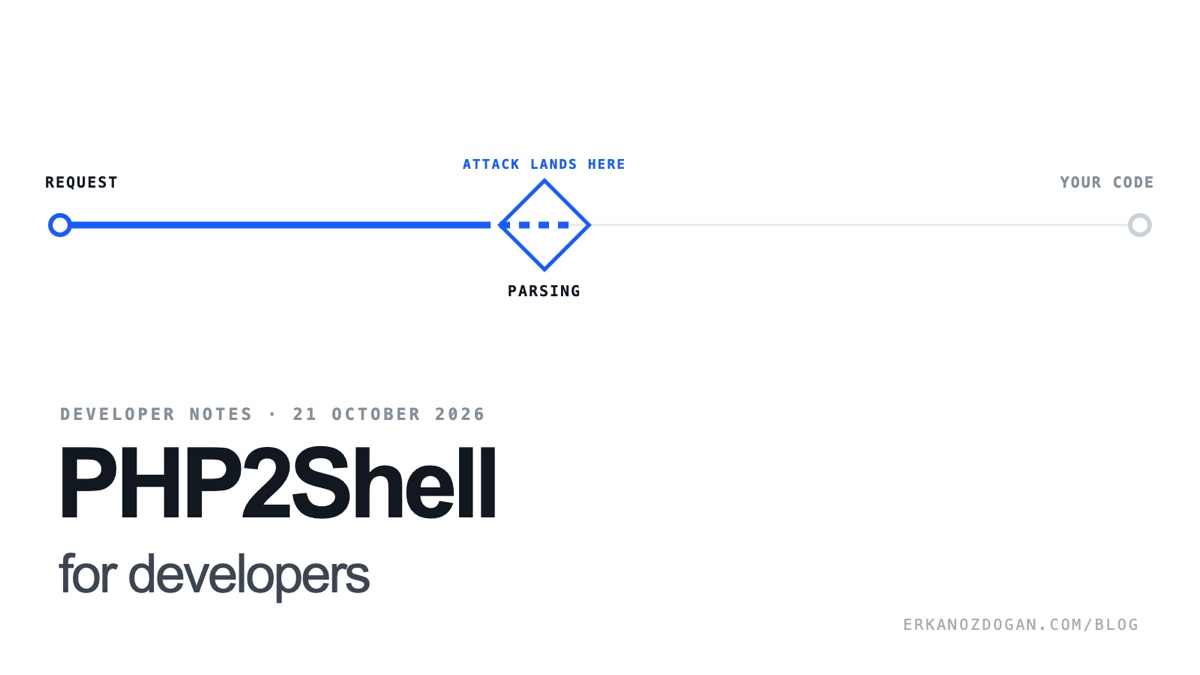
Most vulnerabilities give developers something to fix in their own code. PHP2Shell does not, and that is what makes it unusual. The two flaws fixed on 21 October 2026 fire while PHP is still parsing the request, before the first line of your framework runs, so validation, middleware and authentication never get a chance to help. What you do control is how quickly a patched runtime reaches production, and that depends on decisions in your Dockerfiles, process managers and configuration.
TL;DR
- PHP2Shell fires while PHP parses the request, before your framework runs, so no validation in your code can stop it.
- Your Dockerfiles, worker processes and settings decide how long you stay exposed after the fix exists.
- A backported build can report the old version number, so health checks must compare package releases, not only
PHP_VERSION. - Four October 2026 Node.js fixes do depend on your code: Brotli decompression, TLS hostname checks, DNS names and snapshots.
- Rebuild images with
--pull, restart long-lived workers and verify the version in production.
The bugs in one paragraph each
CVE-2026-109618 is an out-of-memory corruption bug. When PHP runs out of memory at the wrong moment, request data can be left half initialized, and the cleanup code then trusts it. CVE-2026-109619 is stale global state: data owned by one request can outlive its memory, and the next request handled by the same worker can use it before it is reset. Both score 9.2 on CVSS v4.0, need no authentication and affect every web SAPI, including PHP-FPM, mod_php, php-cgi, LiteSpeed and FrankenPHP. Fixed releases are PHP 8.2.35, 8.3.36, 8.4.27 and 8.5.12.
Node.js shipped on the same day: 22.23.4, 24.22.1 and 26.12.1 fix ten CVEs, four of them high. Unlike PHP2Shell, several of these do depend on how your code uses the runtime.
Why your code cannot stop PHP2Shell, but your setup can delay the fix
Because the attack lands during request parsing, the useful questions are about delivery, not logic. Is your PHP coming from a base image that was built last month? Does a long-lived worker keep the old binary in memory? Does a setting in your repository make the bug easier to reach? Each of these is a developer decision, and each one can leave a server exposed after the operations team believes it is patched.
Where does your runtime come from, and how does the fix reach it?
The same fix travels by different roads depending on how PHP or Node.js got onto the machine. Knowing the road tells you who has to act.
| Runtime source | Who delivers the fix | What you have to do |
|---|---|---|
Official Docker image (php, node) |
Image maintainers publish new tags | Rebuild with --pull and redeploy |
| Distribution package | The distribution, often as a backport | Update the package and restart services |
cPanel EasyApache 4 (ea-php) |
cPanel and CloudLinux, as a backport with the same version number | Confirm the package changelog, restart FPM |
| FrankenPHP or Octane binary | The project’s release | Delete and re-fetch the binary, restart the server |
| nvm, fnm or a version manager | You | Install the new version and switch every service to it |
| Runtime bundled in a vendor product | The vendor | Ask for a patched build; do not swap it underneath |
A field note: the patched build that reports the old version
On our own servers the PHP2Shell fix arrived through EasyApache 4 on the afternoon of 21 October, as a backported package. The build was patched, yet PHP_VERSION still read 8.4.26, because the backport changes the package release, not the PHP version. A health check that compares PHP_VERSION with 8.4.27 would have reported a patched server as vulnerable, and a check that only looks for any 8.4 build would report an unpatched one as fine.
So a version check in your application or monitoring has to know where the runtime comes from. For upstream builds, compare the version. For distribution and panel packages, compare the package release or read the changelog for the CVE number.
Node.js: four fixes that do touch your code
Brotli, CVE-2026-111497. An out-of-bounds write in the Brotli decoder permits remote code execution. Any service that decompresses untrusted input with zlib.createBrotliDecompress(), or accepts br-encoded request bodies, is on the attack path until it runs a patched build.
TLS hostname checks, CVE-2026-106069 and CVE-2026-105483. Certificates could be accepted for hosts written as loosely parsed or fullwidth IP addresses. If your code builds URLs from user input or configuration, normalize hosts before connecting, and never replace checkServerIdentity with a looser version.
DNS, CVE-2026-105482. dns.resolve truncated names at a NUL character, so evil.example\0.trusted.example could resolve as something else. Reject control characters in hostnames at your boundary.
Snapshots, CVE-2026-106074. The entropy caches behind crypto.randomUUID() and randomInt() were saved into startup snapshots and single executable applications, so every process repeated the same values. If you ship a snapshot or SEA, rebuild it with the patched release and rotate anything those values protected.
Check a Node.js build against the October release:
What should developers hand to the operations team?
During an emergency like PHP2Shell the slowest part is often not the patch but the questions in between. A development team can shorten the response by keeping four answers ready for every service, written down where the operations team can find them without a meeting.
- Where the runtime comes from. Base image and tag, distribution package, panel build or vendor bundle, from the table above.
- What has to restart. Web workers, queue workers, schedulers, Octane or PM2 processes, and in what order, so nothing is left on the old binary.
- Which settings the application depends on. For example whether it really uses upload progress, or needs a memory limit above the default for a known heavy job.
- How to prove it is fixed. The health endpoint or log line that reports the runtime version and package release.
With these four answers, an operations team can patch, restart and verify a service without waiting for the developer who knows it, which is exactly the situation an emergency release creates.
What are the common mistakes when patching a runtime?
Most failed runtime updates fail in the same few ways. Pulling a newer tag on a running host and assuming the container changed, when nothing was recreated. Updating the web image but not the separate image that runs cron jobs or queue workers. Patching PHP-FPM while the command-line PHP used by scheduled tasks stays on an older build. Leaving a .nvmrc, .tool-versions or CI matrix pinned to an old Node.js version, so the next build quietly reinstalls it. And declaring victory from a Dockerfile diff instead of a version read from the running service.
Each one leaves a service on the vulnerable runtime while the change log says it was patched. The checklist below is ordered to avoid them.
Before you deploy the fix
- Find every runtime you ship. Base images, FrankenPHP or Octane binaries, Lambda layers, CI images and local toolchains all carry their own PHP or Node.js.
- Check your settings in the repository. Remove
memory_limit = -1fromphp.ini, Docker and Helm values, and disablesession.upload_progress.enabledunless your application shows upload progress bars. Put these inphp.inior the FPM pool, not inini_set(). - Pin the patched floor. Set PHP
^8.4.27or the matching fixed release for your branch in your platform checks andengines.nodeto>=22.23.4, so a stale image fails the build instead of shipping.
After you deploy
- Rebuild, do not retag. Use
docker build --pulland recreate containers; pulling a moving tag on a running host changes nothing. - Restart long-lived workers. Laravel queues, Octane, Swoole, RoadRunner, Supervisor jobs and PM2 processes keep the old runtime until they restart.
- Verify what actually runs. Log
PHP_VERSIONandprocess.versionat startup, or expose them on an internal health endpoint, so you can prove the version in production rather than in the Dockerfile. - Undo temporary workarounds. Restore
pm.max_requests, re-enable features you switched off, and remove any multipart blocking added at the proxy once the patched build is live. - Make the next one boring. Automated pull requests for base images and runtimes turn the next emergency into a merge and a deploy.
For the earlier 2026 fixes read layer by layer, see patched runtime, unpatched code; for the trust-store changes of the same week, one compromised CA, many trust stores.
The short version
PHP2Shell is a rare case where application code has no part to play in the defense, and that makes the delivery path the whole story. A team that knows where each runtime comes from, what has to restart and how to prove the running version can move from advisory to verified fix in hours. A team that has to find out during the emergency loses most of that time to questions, which is exactly when attackers with a leaked exploit are fastest.
FAQ: PHP2Shell for developers
Input validation vs a patched runtime: which one stops PHP2Shell attacks in 2026?
Only the patched runtime. The attack happens while PHP parses the request, before any framework, middleware or validation code runs. Only a patched PHP closes it; a WAF in front can reduce exposure while you deploy.
Do Docker images need to be rebuilt for PHP2Shell, or is updating the host enough?
They need to be rebuilt. A container uses the PHP inside its image, whatever the host has installed. Rebuild from a patched base with docker build --pull and recreate the containers.
Do Laravel queue workers and Octane need a restart after the PHP2Shell update?
Yes. Long-running PHP processes keep the old binary in memory. Run php artisan queue:restart, restart Octane, Swoole or RoadRunner, and restart any Supervisor jobs.
Why is memory_limit = -1 risky in the context of CVE-2026-109618?
Because CVE-2026-109618 is an out-of-memory bug, and an unlimited memory limit makes the conditions around it easier to reach. Set a real limit in php.ini or the FPM pool, sized for your heaviest legitimate request.
Will disabling session.upload_progress break file uploads in my application?
Uploads keep working. Only the upload progress feature stops, which a few applications use to show progress bars through the session. If yours does, keep the patch as the real fix and accept the missing bar for a short time.
Which Node.js services are exposed to the Brotli decoder bug fixed in October 2026?
Any service that decompresses untrusted Brotli data, whether through zlib.createBrotliDecompress() or by accepting br-encoded request bodies. Update to 22.23.4, 24.22.1 or 26.12.1, and do not accept compressed bodies you do not need.
How should application code validate hostnames after the dns.resolve NUL fix?
Reject any hostname that contains control characters, including NUL, at the boundary where it enters the system, and normalize it before use. The runtime fix stops the truncation, and the validation stops the input from reaching it.
Why must Node.js single executable applications be rebuilt after the October 2026 release?
Because CVE-2026-106074 saved the entropy caches of crypto.randomUUID() and randomInt() into snapshots and SEAs, so every process repeated the same values. Rebuild with the patched release and rotate anything those values protected.
PHP_VERSION vs package release: what should a health endpoint report after a backported fix?
Report the version and, for packaged runtimes, the package release. A patched backport can show the old upstream version, so a version-only check gives the wrong answer on panel and distribution builds.
How can a team make the next emergency runtime update routine?
Let Dependabot or Renovate open pull requests for base images and runtime versions, keep CI able to build and test on a new image in minutes, and log the runtime version at start-up so the result is visible in production.
Sources
- PHP security release, 21 October 2026, php.net
- GHSA-w8hw-w9fx-j79w (CVE-2026-109618) and GHSA-6wmf-4rv5-p3rp (CVE-2026-109619), GitHub
- October 2026 security releases, nodejs.org
- How to apply the PHP2Shell patches, ma.ttias.be